Viewer count is the wrong number: why chat engagement ratio matters more
Average viewers measures reach, not community. Here is how to calculate your chat engagement ratio, what moves it, and how to use it without fooling yourself.
6 min read

Average viewers is the number every streamer watches. It decides how you feel after a stream, how you compare yourself to others, and often how sponsors size you up.
It is also a surprisingly poor measure of whether your channel is healthy. Viewer count tells you how many people had your stream open. It says nothing about whether any of them were actually there — talking, reacting and coming back.
That is what chat engagement ratio is for.
What is chat engagement ratio?
Chat engagement ratio is the share of your audience that takes part in chat. The simplest version is:
Chat engagement ratio = unique chatters ÷ average viewers
If 120 people watched on average and 54 different people chatted at least once, your ratio is 45%.
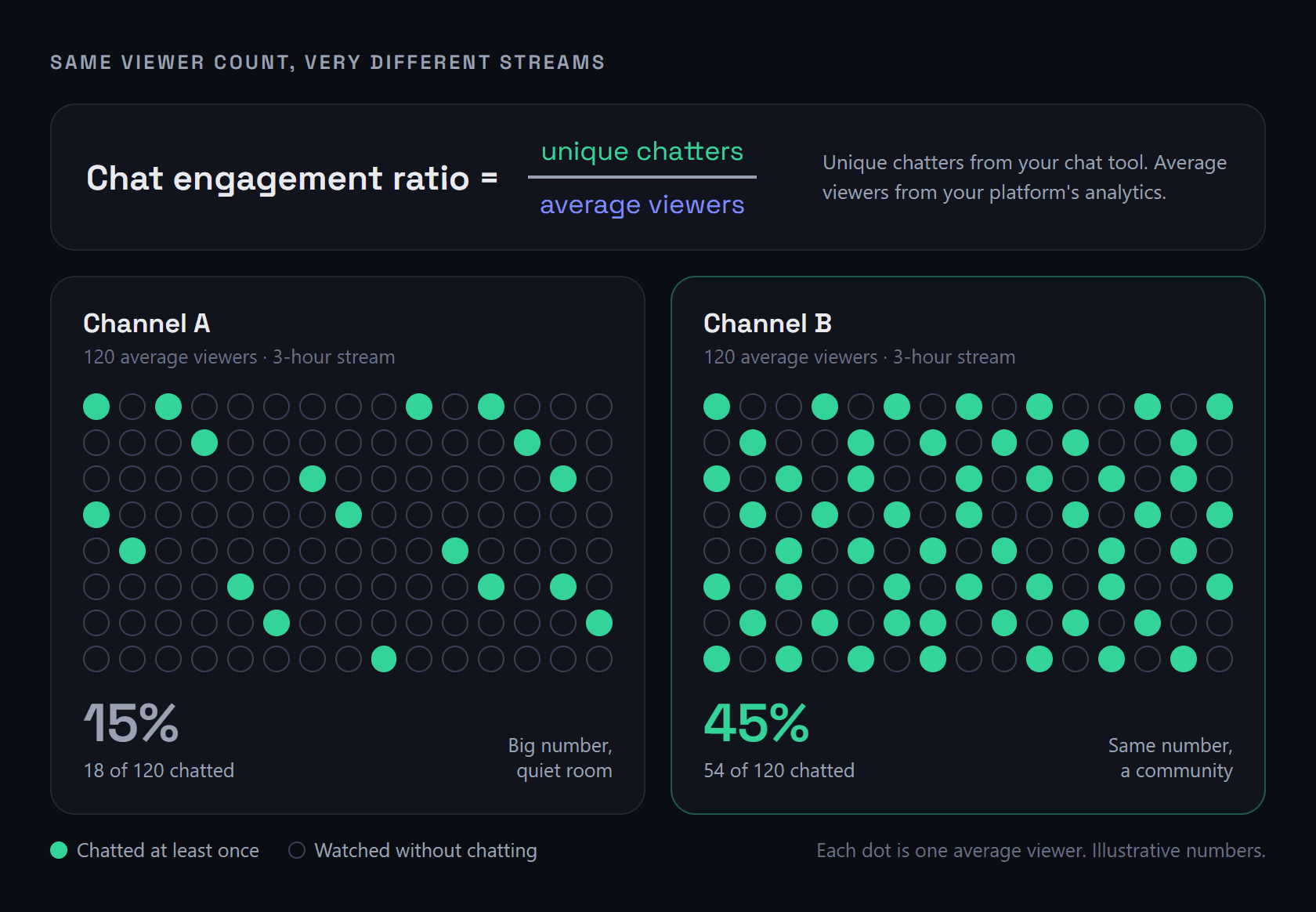
Same viewer count, very different streams. Illustrative numbers.
Both channels above would look identical on a viewer-count leaderboard. Only one of them has a room full of people who know each other's names.
Why viewer count misleads
Viewer count is a measure of reach. It goes up for reasons that have little to do with your community:
- Raids and hosts bring a crowd that mostly leaves within minutes.
- Category and front-page placement add viewers who are browsing, not staying.
- Open tabs and embeds count people who are not watching at all.
- Lurkers — who are valuable, but invisible in the numbers.
None of those make viewer count useless. It is still the best measure of how many people your stream reaches. But a channel can grow its viewer count while its community quietly shrinks, and viewer count alone will never tell you.
How to calculate your chat engagement ratio
You need two numbers from the same stream:
- Average viewers. Take this from your platform's analytics — Twitch's stream summary, YouTube Studio, or your Kick dashboard.
- Unique chatters. The number of different people who sent at least one message. StreamBuddy shows this in your post-stream recap and on the Insights page, across every connected platform.
Divide the second by the first. Do it for your last ten streams and you have a baseline.
What is a good chat engagement ratio?
There is no official benchmark, and comparing your ratio with another channel's is mostly meaningless. Content type changes everything:
- Just Chatting and community streams naturally have high ratios — talking is the content.
- Competitive or story-heavy games have lower ratios, because viewers are watching closely rather than typing.
- Smaller channels usually have higher ratios than bigger ones. It is easier to talk in a room of 20 than a room of 2,000.
- Long streams inflate unique chatters compared with average viewers.
The useful comparison is with yourself. Is your ratio higher on Fridays than Tuesdays? On one game than another? Higher this month than three months ago? Those answers are actionable.
Better signals than a single ratio
A ratio is a starting point. These are the numbers that tell you why it moved:
| Signal | What it tells you | Where to find it in StreamBuddy |
|---|---|---|
| New vs returning chatters | Whether chat is growing or just the same faces | Recap email, Insights → New vs returning |
| Repeat attendance | Whether people come back stream after stream | Insights → Repeat attendance trend |
| Peak active chatters | How many people were talking at the busiest moment | Recap email, Insights |
| Chat spikes | Which moments made chat come alive | Insights → Spikes worth replaying |
| Chat themes | What the room kept talking about | Insights → What the room kept coming back to |
| Regulars going quiet | Community members you are losing | Insights → At risk |
If your ratio is falling, the table tells you where to look. Fewer returning chatters means retention; fewer new chatters means discovery; fewer spikes means the content itself.
How to raise your chat engagement ratio
You cannot force people to chat, and you should not try — begging for messages makes streams worse. But you can make chatting easier and more rewarding:
- Reply to people by name. Viewers chat more in streams where messages get answered.
- Ask questions with easy answers. "1 or 2?", "what would you pick?" and "where are you watching from?" give quiet viewers a low-effort way in.
- Welcome first-time chatters properly. A real reply to someone's first message is the strongest signal that chatting is worth it. Turning first-time chatters into regulars covers how.
- Remember what people told you. Bringing up something a viewer mentioned last week is the most powerful engagement tool you have.
- Leave space. Constant talking leaves no room for chat to respond. Pause, read, react.
Using engagement when you talk to sponsors
Brands increasingly ask for more than average viewers. A channel with modest viewer numbers but an active, returning chat can make a stronger case than a bigger channel with a silent audience.
Be honest with the numbers. Explain how you measured them, compare like with like, and show trends rather than one great night. "Our chat engagement ratio has held around 40% for three months, and 70% of chatters are returning viewers" is a credible story. The chat engagement ratio page explains how StreamBuddy helps you put it together.
Frequently asked questions
How do you calculate chat engagement ratio?
Divide the number of unique chatters in a stream by your average viewers for the same stream. 54 unique chatters with 120 average viewers is a 45% ratio.
What is a good engagement rate on Twitch?
There is no official standard, and it varies hugely by category, stream length and channel size. Track your own ratio over time and compare streams with each other rather than with other channels.
Why is my chat engagement ratio over 100%?
Unique chatters is counted across the whole stream, while average viewers is a typical-moment snapshot. On long streams with a lot of turnover, more people chat in total than were watching at once.
Does StreamBuddy show average viewers?
StreamBuddy focuses on the chat side: unique chatters, new and returning chatters, peak active chatters and how they change over time. Take your average viewers from your platform's analytics and combine the two.
Is a higher chat engagement ratio always better?
Usually, but not always. Some formats are meant to be watched quietly, and lurkers are a real part of any audience. Use the ratio to spot changes and ask why, not as a score to maximise at any cost.
See who is actually in the room
StreamBuddy tracks unique, new and returning chatters across every platform you stream on, so you can measure community — not just reach.
Try StreamBuddy- chat engagement
- stream analytics
- engagement ratio
- community growth
- twitch analytics